an unconventional movie for christmas
Mr. Soft Touch (Gordon Douglas and Henry Levin, 1949)
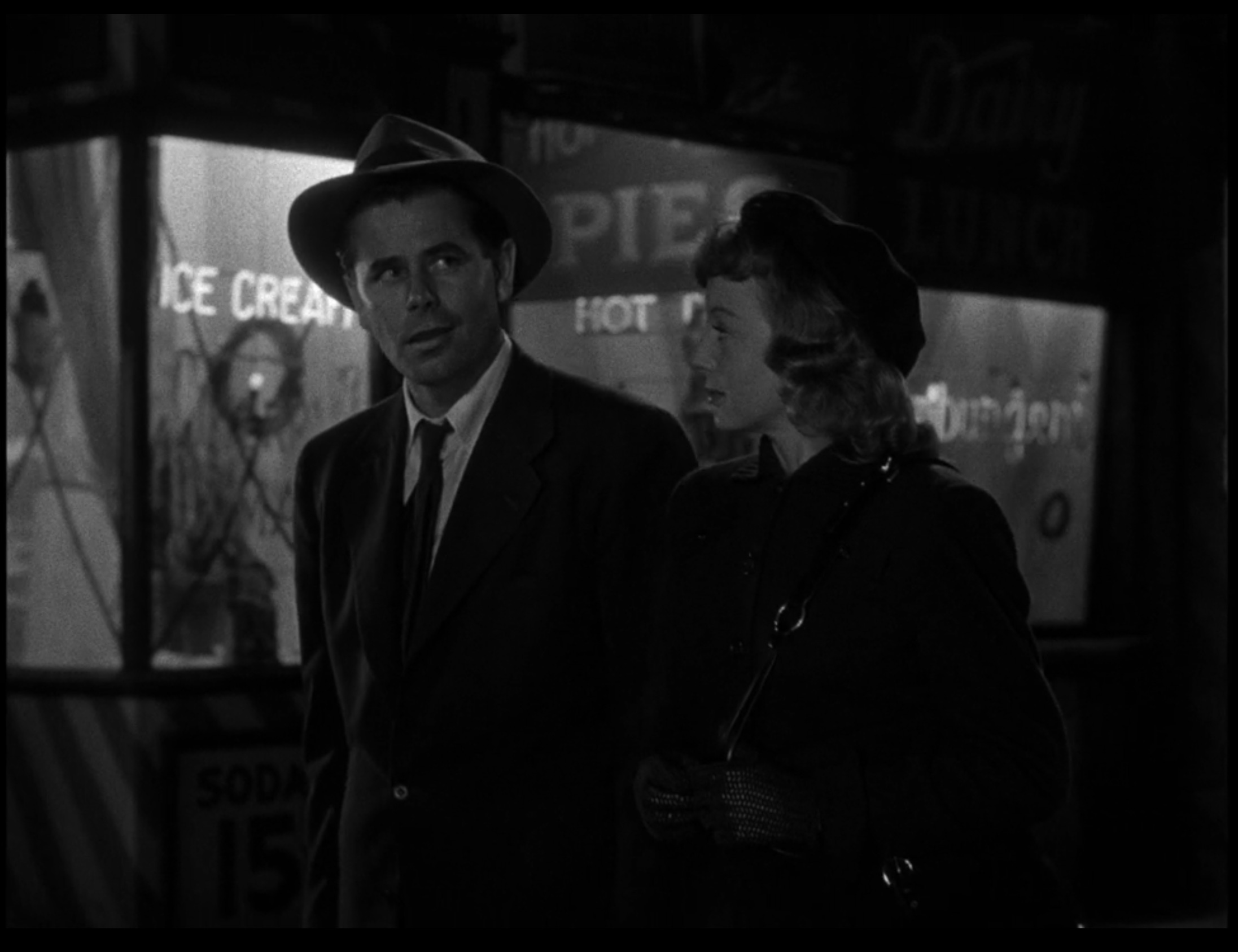
Imagine, if you will, a movie about a charming ruffian and a principled social worker falling in love. Now imagine a movie that is about a war veteran who’s stolen a lot of money from the mob on the run before they feed him into a cement mixer. Now imagine a Christmas movie. Now imagine these are all one movie. Now imagine that this single movie is directed by two different men, who, between them, have maybe produced one other movie you’ve heard of or seen.1 Now imagine the male lead of this movie is called, for real, “Joe Miracle.”
That’s Mr. Soft Touch. It sounds like a disaster and it really should be a disaster. But it’s not. Its shifts in tone should be comically severe but… it all works.
Joe Miracle (Glenn Ford) used to run a club with his friend Leo. But then Joe went off to war, and when he came back home, Leo had disappeared and the club has been taken over organized crime. We meet Joe right after he has robbed club to retrieve what is, essentially, his own money out of its safe. He plans to get on the first boat to Yokohama. Except that when he goes to pick up his ticket from Leo’s brother Victor and sister-in-law, it turns out the next boat to Yokohama doesn’t leave for 36 hours. Between now and then, Joe has to stay one step ahead of the people who will be looking for him—not just the mob, but also the police (he did steal the money, after all).
But how?
Opportunity presents itself in the form of the police, who have come to arrest Leo’s brother on a noise complaint. (Victor also stands accused of beating his wife, which matters for plot purposes, but for the record we never see any such thing happen and I think the movie suggests this is just gossip from the neighbors.) Joe impersonates Victor and plans to spend the night in jail, the one place neither the police nor the mob would expect to find him. Except that Jenny Jones (Evelyn Keyes), a social worker, comes following on the heels of the police, and she argues that this man shouldn’t be sent to jail. He needs help, not prison. And it’s practically Christmas—you’re going to jail a man on Christmas? And so Joe, despite his best efforts, doesn’t end up in jail but in a settlement house. He’s going to be reformed out of making noise and beating his wife. Is he in fact a guy who does those things—no, but he decides he might as well enjoy playing the character.
One of the major pleasures of movies about confidence men is watching characters who think on their feet, and an additional pleasure when it comes to Joe is that we really want him to succeed. In one scene, Joe’s decided he’s going to get the settlement house a new piano. He knows a nearby piano store is really a gambling front, so he goes to finagle a piano out of them. We see him stroll through the settlement house picking out the best elements of other men’s clothing. When he arrives at the store, the clothing, plus his posture, causes the proprietor to assume that he’s from the DA’s office and will bring the law down on the place if they don’t bribe him with a free piano. Joe barely even lies.2 You don’t get the sense he walked into the store with a clear plan, just that he knew what the right clothes would be. At another point in the movie he dresses up as a Santa Claus to escape detection. It feels right. And sometimes he tries on a character bit and it feels a little wrong.
All of the success of Joe, the character, can be put down to Glenn Ford. This movie unites so many disparate tones that without the right cast it’s going to fall apart. Glenn Ford is the right man for this job. He is so damn likeable. He has a smile he can never suppress for very long, even when things get dark. He has an instinct for the right gesture, the right tone, the gallant move, though he does these things so correctly you can’t always tell if he’s sincere. There’s a kind of movie star whose charisma comes from the way they don’t seem like a movie star; they are not the Everyman, which is too exalted-sounding, they’re more like the Everyguy. James Garner is an Everyguy and Glenn Ford is an Everyguy. They exude a natural ease and flirtatiousness that extends even to the camera.
Evelyn Keyes, playing Glenn Ford’s romantic interest and foil, had starred opposite Ford several times before Mr. Soft Touch and that gives the two of them a natural chemistry, albeit a chemistry they each find alarming at different times and for different reasons. In a non-literal sense, Keyes’s Jenny forms the bridge between the very real violence of the criminal underworld and the funny antics of the settlement house, because she walks in both worlds. When Joe cruelly accuses her of slumming it, she pushes back her hair to reveal that she has to wear a hearing aid; her father beat her as a child so badly she went deaf. She knows the police (and Joe) view her as an easily manipulated bleeding heart, but she doesn’t live in denial of human evil or violence. She just thinks she’s stronger than they are.3 She can stand out like a good deed in a naughty world, as Shakespeare puts it.
There’s a third crucial character in this movie: Harry Byrd, a reporter played John Ireland. He shows up late, has only a few scenes, and almost doesn’t feel real, because most of his significant conversations are one on one with Joe. He doesn’t care about anything but getting a good story and he knows somebody in the police force must be covering for the mob. He just wants the name so that he can get a big story. He doesn’t care about anything else. Even though he presents himself as on Joe’s side, Joe reacts to him with an antipathy so severe it does feel—again—as if this guy cannot possibly be real.
He is real (in the story, I mean), but the function he really assumes for Joe is as a kind of evil conscience: While you were off playing hero in the war, the mob was murdering your best friend, you piece of shit. But Joe can make it all okay, if he just names a name. Which he won’t. Does he even know the name? Harry thinks he does. Still, Joe won’t do it. He does not say he doesn’t know or that he does. He just won’t do it. It’s not a principled stand against ratting. It’s about letting somebody else do the job. He will run away from the situation, sure. He will not go running to somebody else to fix things. Throughout the movie, he messes things up and then fixes his mistakes on his own. He is generous with others but he does not accept help.
But, but, but.… he’s in love with a professional at helping people. And it’s Christmas. At some point he has to accept something from somebody… right? Maybe he does and maybe he doesn’t. I won’t tell you. You have to watch it yourself.
Some of you do not count for the purposes of this sentence.
Is it even really a con job, given the place was never going to sell the piano? This movie is the “could God make a rock so heavy that even he couldn’t lift it” version of “can a character in a movie in 1949 be allowed to profit from his crimes if they don’t really feel like they should count as crimes.”
This moment also redeems the movie’s earlier wife beating jokes, in my opinion—if you laughed at them you will feel bad here, and if you didn’t laugh at them you will feel smug thinking about all the poor suckers who did laugh and have to feel bad now.


this sounds like my situation for more than the last decade. plus the social worker specialized in 'geriatrics'
so, man! i'm in like flint!
Evelyn Keyes, one of our most underrated empathic faces!